



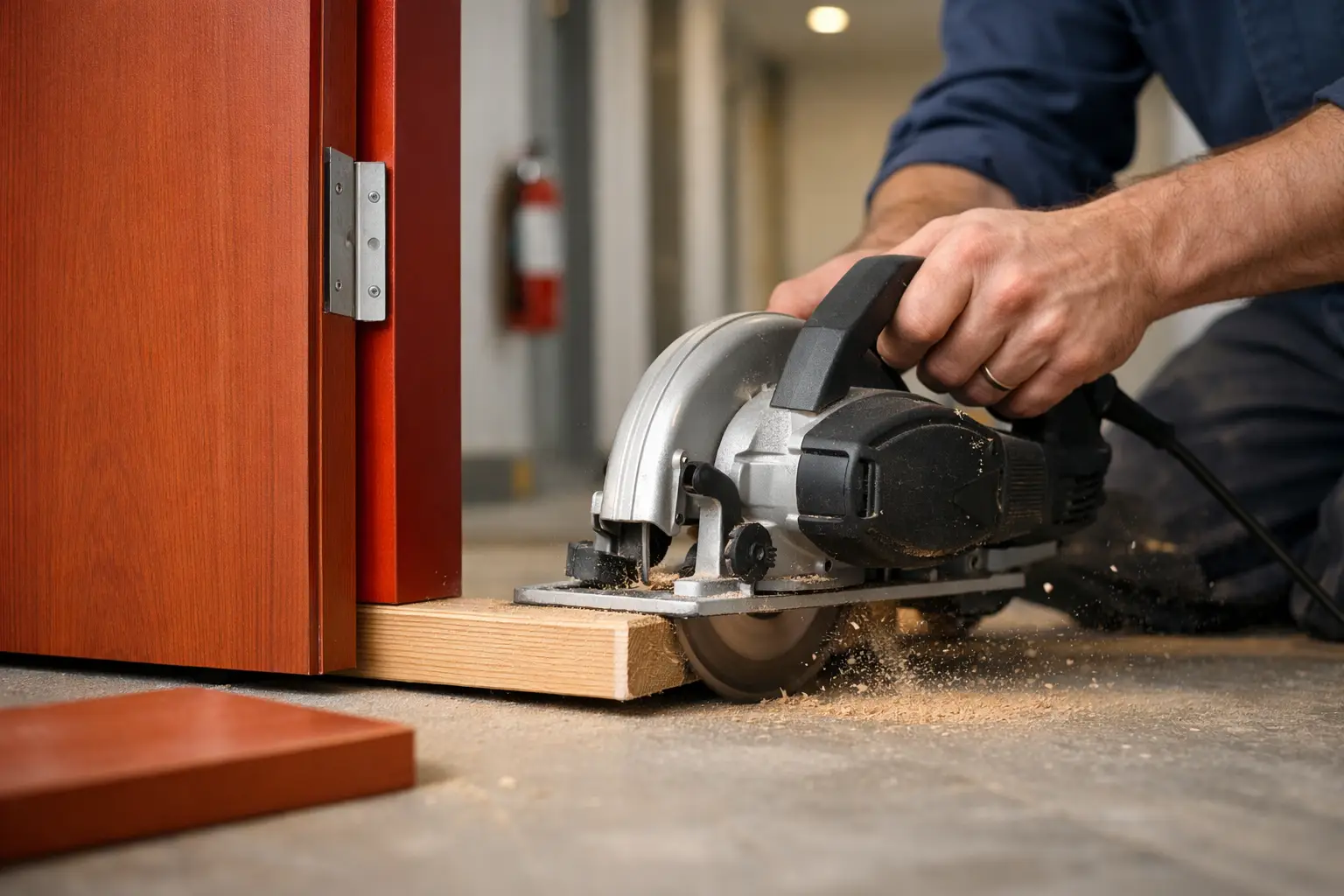
Fire-rated doors play an essential role in protecting buildings by slowing the spread of fire and smoke. They are specially designed and tested to withstand high temperatures for a specified period, helping occupants gain valuable time to evacuate safely. However, during installation or renovation, a common question arises: Can you trim a fire-rated door without losing its fire rating?
The short answer is that it depends on the door’s construction, manufacturer specifications, and the amount of material being removed. While some fire-rated doors allow limited trimming, others must remain completely unaltered to maintain their certified performance.
Understanding the correct procedures is important before making any changes to these doors.
Understanding How Fire-Rated Doors Work
Fire-rated doors are not ordinary interior doors. They are manufactured using specially selected materials and construction methods that help them resist fire and heat. Depending on their design, they may contain solid timber cores, mineral cores, fire-resistant boards, or other specialized materials.
Their performance depends on more than the door panel itself. Frames, hinges, locks, seals, glazing, and other hardware must also meet the requirements of the tested door assembly.
When correctly installed, these components work together to help prevent flames, heat, and smoke from passing between different areas of a building.
This is why Fire rated interior doors must be handled carefully whenever adjustments or modifications are necessary.
Can You Trim a Fire-Rated Door?
Yes, certain fire-rated doors can be trimmed, but only when the manufacturer specifically permits it. Many fire-rated door models have strict limits on how much material can be removed from their edges.
Some doors are manufactured with trimming allowances built into their construction. These allowances provide extra material around the edges, allowing installers to make small adjustments without exposing the internal core or compromising essential components.
However, removing too much material can damage the door’s protective structure. It may expose the core, weaken the edge construction, or interfere with the performance of intumescent seals.
Before trimming any fire-rated door, always check its certification documents and installation instructions. If the permitted trimming allowance is unclear, contact the manufacturer or a qualified fire-door specialist.
Why Excessive Trimming Can Affect a Door’s Fire Rating
A fire rating is achieved through testing under specific conditions. Manufacturers design and test doors as complete assemblies, and unauthorized modifications can change how they perform during a fire.
Here are some important reasons why excessive trimming can create problems.
1. It Can Expose the Internal Core
Many fire-rated doors contain specialized internal materials that help resist heat and flames. Removing too much material from the edges may expose or damage these materials.
In some constructions, the door also relies on carefully designed edge components to maintain its structural integrity. Once these areas are altered, the door may no longer perform as originally tested.
2. It Can Damage Intumescent Seals
Intumescent seals are important components of many fire-rated door systems. They expand when exposed to high temperatures, helping close gaps between the door and its frame.
If trimming damages or removes these seals, the door may not provide the intended level of fire protection.
Even a small adjustment can create problems if the seal is incorrectly positioned or interrupted.
3. It Can Weaken the Door’s Edges
The edges of a fire-rated door are often constructed to meet specific performance requirements. Removing excessive material may weaken these areas or expose materials that were not intended to remain uncovered.
This can affect the door’s ability to maintain its structure during exposure to high temperatures.
4. It Can Affect the Door’s Certification
Fire-rated doors are tested and certified according to specific construction details and installation conditions. Unauthorized changes can take the door outside the scope of its certification.
Even if the door looks perfectly normal after trimming, its original fire performance should not be assumed.
How Much Can You Trim From a Fire-Rated Door?
There is no universal trimming allowance for every fire-rated door. The permitted amount depends on the manufacturer, door construction, certification, and applicable building regulations.
Some manufacturers allow limited trimming from specific edges, while others prohibit cutting altogether.
For example, a particular door model might permit a small amount of material to be removed from its vertical edges but have stricter restrictions on the top or bottom. Another model may require all original edge components to remain untouched.
The important thing is to avoid relying on general measurements found online. A trimming allowance that applies to one door does not automatically apply to another.
Always consult the following information:
-
Manufacturer’s installation instructions.
-
Fire-door certification documentation.
-
Product-specific trimming allowances.
-
Requirements for intumescent and smoke seals.
-
Applicable local fire-safety regulations.
If the documentation does not clearly authorize trimming, do not proceed until the manufacturer or a qualified professional confirms that the modification is acceptable.
Which Parts of a Fire-Rated Door Can Be Trimmed?
Different parts of a fire-rated door may have different restrictions. Understanding these differences can help prevent accidental damage.
Top Edge
The top edge may contain important structural materials or components that contribute to the door’s fire resistance. Some manufacturers allow limited trimming, while others do not.
Never assume that the top edge can be shortened simply because the door is too tall for its frame.
Bottom Edge
The bottom edge is often adjusted when a door rubs against flooring or does not provide enough clearance.
However, removing material from this area can affect the door’s construction and its required clearance from the floor. It may also interfere with any bottom seals or drop-down mechanisms.
Only trim this edge when the manufacturer explicitly allows it.
Side Edges
Side-edge adjustments are sometimes necessary when a door does not fit correctly within its frame. However, these edges may contain lippings, protective layers, or other specially designed components.
Removing too much material can expose the internal core or affect the fit of the fire and smoke seals.
For this reason, side trimming must also follow the door’s specific certification requirements.
What Should You Check Before Trimming a Fire-Rated Door?
Before making any adjustments, take time to inspect the door and gather the necessary product information.
Check the Certification Label
Look for the manufacturer’s identification label, plug, or other certification markings. These details can help identify the door model and its fire-resistance classification.
Read the Manufacturer’s Instructions
Find out whether the manufacturer permits trimming and identify the exact limits for each edge. Do not rely on information intended for a different model.
Inspect the Door’s Construction
Check whether the door has solid timber lippings, intumescent strips, concealed seals, or other specialized components. Understanding its construction helps identify areas that should not be altered.
Measure the Door and Frame
Accurately measure the door opening, frame, floor clearance, and existing gaps. Sometimes, the problem can be corrected by adjusting the frame or hinges instead of cutting the door.
Consult a Qualified Professional
If you are unsure about the door’s construction or certification, seek advice from a competent fire-door installer or specialist before making modifications.
Alternatives to Trimming a Fire-Rated Door
If a fire-rated door does not fit correctly, trimming is not always the best solution. Several alternatives may help resolve the problem without modifying the door panel.
Adjust the Hinges
Sometimes, a door rubs against its frame because the hinges are loose, incorrectly positioned, or poorly adjusted. Tightening or correctly adjusting compatible hinges may improve the fit without removing material.
Check the Door Frame
An incorrectly installed or misaligned frame can cause gaps, sticking, and uneven clearances. A professional can inspect the frame and determine whether it needs adjustment.
Consider Suitable Replacement Hardware
In some situations, the wrong hardware may prevent the door from closing properly. Replacing incompatible components with approved fire-rated hardware may solve the problem.
Choose a Different Door Size
If the existing door is significantly larger than the opening, purchasing a correctly sized fire-rated replacement may be safer than attempting extensive trimming.
The replacement should have suitable certification and be compatible with the existing fire-door assembly.
Common Mistakes to Avoid When Modifying Fire-Rated Doors
Making changes without understanding the door’s construction can create serious safety problems. Avoid these common mistakes:
-
Trimming without checking documentation: Never assume that all fire-rated doors have the same cutting allowance.
-
Removing too much material: Excessive cutting can expose the core and damage essential components.
-
Cutting through fire seals: Damaged or missing seals can affect the door’s ability to resist fire and smoke.
-
Using ordinary replacement materials: Standard adhesives, fillers, and seals may not be suitable for certified fire-door assemblies.
-
Ignoring manufacturer instructions: Even seemingly minor changes can affect the door’s tested configuration.
-
Assuming appearance indicates safety: A modified door may look undamaged while no longer meeting its original performance requirements.
Avoiding these mistakes helps protect the door’s intended function and reduces the risk of costly replacement work.
Do Fire-Rated Doors Need Professional Inspection After Trimming?
Yes. If trimming has been permitted and carried out, the modified door should be checked to confirm that it still complies with the manufacturer’s requirements and applicable fire-safety standards.
A competent professional can inspect the door’s edges, seals, hardware, gaps, closing operation, and overall condition.
They can also determine whether the modification remains within the scope of the door’s certification.
If unauthorized material has been removed or important components have been damaged, the door may need repair using an approved procedure or complete replacement.
Professional inspection is particularly important in commercial buildings, apartment complexes, hotels, hospitals, and other properties where fire-door performance is critical.
Are All Fire-Rated Interior Doors Designed for Trimming?
No. Fire-rated doors come in different designs, materials, and certification categories. Their ability to withstand fire depends on the specific construction and testing requirements associated with each model.
Some products are designed with additional edge material to accommodate limited adjustments. Others have tightly controlled dimensions and must not be cut after manufacturing.
When choosing Fire rated interior doors, it is helpful to consider installation requirements before purchasing. Selecting the correct size from the beginning can prevent unnecessary modifications and reduce installation complications.
Homeowners, contractors, and property managers should also confirm that the selected door is suitable for its intended location and meets applicable building regulations.
Final Thoughts: Protect the Fire Rating Before Making Any Changes
Trimming a fire-rated door is possible in certain circumstances, but it should never be treated like cutting an ordinary interior door. The amount of material that can safely be removed depends on the door’s manufacturer, construction, and certification requirements.
Before making any adjustments, review the product documentation, check the permitted trimming limits, and inspect the door’s seals and internal structure. If the required modification exceeds the manufacturer’s allowance, replacing the door with a correctly sized model is usually the safer option.
Ultimately, the purpose of a fire-rated door is to provide reliable protection when it matters most. Preserving its certified construction, using approved components, and arranging professional inspections help ensure that it continues to perform its intended safety function.
